It's 1981 and I'm in Liverpool - in Toxteth to be precise...
I've come for a party with some friends. There are still bricks in the streets from the riots some months earlier. The party is in some sort of gym near a church from memory. It's a bit hazy and the situation looking back is a bit sketchy...
This song is played by someone on the record player... and then it is played again and again...
It doesn't tackle the theories of ridge push and slab pull, or the issues with relying on convection currents.
Instead, as this analysis suggests:
"....it metaphorically explores the dynamics of love over time, comparing romantic relationships to the slow, inevitable movement of tectonic plates. The song captures how love, like continents, gradually changes and shifts, sometimes leading to separation.
The reference to “the eastern coast met the western shore” symbolises two individuals from different backgrounds or lives uniting. The imagery of land masses fitting “like a glove” suggests a natural, perfect connection between two people.
The “glacial measured motion” metaphor suggests that while the change is slow, it is steady and unstoppable. “Fault lines” here symbolise the underlying issues or differences that cause a gradual divide."
He has recently co-authored a book called Cities in the Metaverse, which tracks how digital technology is transforming the way we think about cities. The album, Place and Space, is an accompanying piece which functions as a fun way into the timely subject matter. Heavy on synthesisers, arpeggiators and four-to-the-floor kick drum, it’s the sort of euphoric trance many would sooner associate with a festival than a lecture theatre.
One of the other co-authors of the book that inspired the album is Duncan Wilson, also of UCL. I worked with Duncan and other organisations on a project called DISTANCE some years ago. I was working with Helen Leigh and other colleagues at Explorer HQ on a project exploring the Internet of Things and how it could be taught in schools. This was back in 2013.
It's over 15 years since I went to Latitude festival with the Mission:Explore team. This followed an earlier visit to Glastonbury in the same year.
We were working in the children's area running our missions, entertaining young people amongst the festival goers with our subversive take on the festival and its surroundings. Once we'd finished our shift, we were free to enjoy the music. On the 2nd evening, I headed over to the tent where Jonsi from Sigur Ros was going to be performing that evening. I caught a set from American band Yeasayer who were excellent. I then noticed someone wandering in a familiar tasselled jacket and realised it was Jonsi, and had a brief conversation with him. It was just after the launch of his 'Go' album, which remains one of my favourites.
Later that evening he gave the most amazing performance in this tent, and I was up front as the music unfolded. It remains a musical highlight.
For a taster, catch the track on this film here...
In 2025, Jonsi released the album 'First Light'
It features a lot of natural sounds such as birdsong...
“Writing this music at a time of manmade global turmoil and unrest for a video game. I imagined First Light as a momentary fantastical, over-the-top, utopian world where everyone and everything lives together in everlasting peace and harmony. Choosing beauty over disorder, hope over fear, our universal divine angel guardians watching over us and connecting us all as one through love, melody, and music.”
There are locations which we perhaps associate with music because of particular concerts. Heaton Park will be an important place for Oasis fans for example following 2025's reform tour.
One place I spent a lot of time in the 1980s and 1990s was Wentworth Folk Club.
Wentworth is a small village between Rotherham and Barnsley.
The club was formed in September 1974 by a close-knit group of like-minded musical friends at its original home, The Rockingham Arms, Wentworth. Initially on Thursday evenings, it met every fortnight until the “Rock’ renovated its barn which became a perfect live music venue. This enabled the club to convert to a weekly Friday night club in 1977. Over time one of the founders, Rob Shaw, became the mainstay and his foresight and industry enabled the club to become one of the premier live folk music venues in the UK and in 2004 won the prestigious Radio Two Folk Club Of The Year award.
After 32 years at the ‘Rock’ the club was forced to change its location.
I saw some great bands there over the years...
Dick Gaughan
Isaac Guillory
Liam o' Flynn
Vin Garbutt
Chris While and Julie Matthews
Alias Ron Kavana
Bernard Wrigley
Does anyone else have memories of 'The Rock' or another folk club perhaps?
Image: Rockingham Arms, Wentworth - Alan Parkinson - shared on Flickr under CC license
Here's the title track of the new album from Finland's Kebu (Sebastian Teir) an electronic musician who uses analogue synths and produces engaging and melodic music.
It was released today.
I have a signed copy of the CD on its way to me - posted by the artist themselves a few days ago.
They have a major new tour coming up, but sadly the logistics of getting into the UK to perform were too great. Thanks Brexit...
If you haven't seen this yet, it's about Tony Mammoth, a PE teacher who goes on a ski-trip in the 1970s and gets caught in an avalanche. Forty years later he is found and brought back to life... and gets a job back in teaching - bringing a 1970s mentality to the present day (a reverse 'Life on Mars').
Cue Parents' evenings as speed dating, driving his car onto the football pitch while teaching, and sunbathing in the long jump pit...
And a few geography teacher jokes thrown in of course...
He no longer knows the rules of society. He can’t smoke a pipe at school. Modern women don’t like it when he chats them up at all times. He leaves the engine of his Ford Capri running to “keep it warm”. Drink-driving is no longer “fashionable”. There is no longer a woodwork department at the school, which baffles him: “What do you do with the thick kids?”
How else to give it a 1970s vibe?
How about a 1970s title sequence, and music by Mike Post!
Mike Post has written a number of classic theme tunes. They include The A-Team, the Rockford Files - a classic - and Hill Street Blues - another classic.
They are similar in tone to the work of Dave Grusin.
In early July, the Prince's Teaching Institute is organising a Geography symposium.
It's shaping up to be an excellent couple of days down at the RGS in London (or up depending on where you are based), organised by the PTI with the RGS and GA.
The programme for the event is beginning to be shared on the website. The event includes overnight accommodation and breakfast and a gala dinner with guest speakers.
Yesterday morning, I checked the updated programme and was very excited to see these two sessions side by side on the draft programme for the event. Obviously there's my session on Everyday Geographies. I've got plenty of ideas to share there, drawing on my Presidential lecture (you'll find lots of related posts on the blog).
If you're not familiar with him, he is the founder, guitarist and songwriter for the most excellent Public Service Broadcasting.
You will also know if you read the blog regularly that I have posted frequently about them, and also on my World of Music blog.
Their albums tend to focus on one theme: the Race for Space, the decline of Welsh coal or the last flight of Amelia Earhart, as well as an album celebrating Berlin.
And here's their take on Everest - a song which always closes their live shows...
I'm very much looking forward to this session, and acting as 'support act'. I'll also be talking about them in Sheffield at the GA Conference in April.
Finally here's a TED talk that he gave, suggesting that live music should go wrong...
The latest in a series of blog posts from Carl Lee. I hope you are enjoying them as much as I am... this one starts on the coast of India back in the late 1980s, when I was just starting my teaching career.
From Goa to John Lewis
In 1988 I found myself heading south from Mumbai on the night-train to Panaji, the state capital of Goa on the west coast of India.
Goa had been a Portuguese enclave, once part of the ‘Estado da India’ that also covered trading ports from Gujarat (Diu) to Kerala (Cochin), with roots as far back as the early 16th century. On India gaining independence from the British Empire in 1947 Goa remained a part of Portugal until 1961 when the Indian army invaded and seized control.
Yet it was not until 1987 that Goa became a full state within India.
Since the late 1960s, Goa had been an integral part of the over-land hippie trail.
To some it was the final destination after Kabul, Kashmir and Kathmandu. An under-ground culture of beach-based hedonism developed, fuelled by hashish from the 3Ks.
I would be disingenuous if I did not admit at this point that such hedonism was part of the attraction of Goa as I headed south on the train, and the fact that it was one of the few places in India you could get a cheap cold beer.
Christmas was coming and Goa was beckoning.
I stayed for 6 weeks; co-renting an old, falling down, Portuguese colonial house from a nun, with its own well and ‘pig toilet’ (don’t ask). It was under a palm grove on the edge of the village of Vagator, a couple miles north of the ‘legendary’ beach resort of Anjuna with its hippie market and full moon parties. I was looking forward to going to a full-moon party and getting down to some Bob Marley, maybe a bit of soul and funk. What I wasn’t expecting was what I initially disparagingly called Italian electro-disco but later found out was some of the very early roots of acid house music. When was anybody going to put some reggae on?
In the quiet rural Goan nights, finding a party wasn’t difficult - just head towards the thumping beat. And it was that beat, a repetitive four on the floor 120 to 150BPM, which jarred my musical sensibilities. On the beach at Vagator parties kicked off at sunset and rolled on way past sunrise. In such matters I was seriously lightweight - I only knew that they went on post sunrise because they kept me awake, woke me up, or we’d bump into the spaced-out stragglers as we sauntered down to the beach for breakfast.
The disparate nationalities that were drawn to the Goan beach-party scene at that time were primarily European, a fair number of Australians and a surprisingly large Israeli contingent. Plenty of life’s flotsam; its damaged, its wayward, its idealistic and hedonistic was washing up on those Goan beaches but what they were listening too had legs way beyond the sand.
The mash-up of electro, house and trance sounds that were being explored by those pioneer Goa DJs proved to be influential on the birth of acid house and its multitude of sub-genres that blossomed in the UK from 1988 onwards. It even spawned its own sub-genre ‘Goa Trance’ which had a particularly strong following in Israel with acts such as Astral Projection, Infected Mushroom and Astrix to the fore.
Geographer Arun Saldanha’s 2007 book ‘Psychedelic White: Goa Trance and the Viscosity of Race’ ethnographically deconstructs the Goa dance culture through the prism of a materialist theory of race, which Brown University academic Masha Hassan extended with her 2025 analysis entitled “India’s Right-Wing Raves: Hindutva, Zionism and Psychedelic Trance’.
You can waste an hour or so looking back on these Goan beach parties on You Tube with this one of ‘Goa trance party at Vagator, Goa 1992’ being pretty much as I remember, albeit four years previously.
Goa trance party at Vagator, Goa 1992
Wild abandon on the dance floor where nobody cared what shapes you were throwing, and tracks that went on and on until they changed and you had not really noticed. Look closely and you’ll see that this is broadly a ‘Western’ event with locals relegated to servicing events: chai, food and taxis.
The burgeoning dance music scene that exploded across the UK in the late 1980s and early 1990s became a significant cultural game-changer as well as having significant social impacts. It was open, accepting and crossed ethnicities and classes.
It was not long before dance music escaped its under-ground transgressive vibe; the illegal raves in fields, warehouses, Castlemorton Common, SMS messages and the wave of ecstasy.
By the early 1990s dance music jumped up everywhere, the charts, in the high street clubs and was cemented in popular culture when Primal Scream’s 1991 album ‘Screamadelica’ won the inaugural 1992 Mercury Music Prize.
Here's the track 'Movin' on up'.
In 2025 the much-anticipated John Lewis Christmas television ad referenced those heady days of dance music frenzy to a generation now much more grown-up.
A father and his son on Christmas Day, hesitant around each other, make a connection through the gift of Alison Limerick’s 1990 floor-filler of a groove ‘Where Love Lives (Come On In)'.
A track artfully selected by John Lewis’s ad company for maximum emotional impact. The father drops the needle and is taken back to those hedonistic dance floors of the 1990s when optimism was still in the air. Limerick's track was so explosive at the time blowing up clubs all over the world that early acid house DJ Danny Rampling said of in 1992 ‘that it will still sound good in 20 years’, and he is not wrong.
Hear it for yourself with the classic club mix.
It’s a bit more melodic than the squelchy beats and bleeps of the early Goa raves but its connection with them is clear.
From spaced-out raver to ‘centrist dad’. It’s a journey many have probably made.
Carl Lee is retired but was a lecturer at The University of Sheffield and Sheffield Hallam University, taught A level Geography for 20 years at Sheffield College, is the author of five books about geography and has a PhD in economic geography. He has been nuts about music since buying his first single in 1973: 10cc’s 'Rubber Bullets' if you were wondering.
During this expedition through its massive archives, Public Service Broadcasting delved into material outlining the acme and descent of coal mining in the Welsh countryside but J. Willgoose Esq. didn’t stop there. Noting the extensive list of informative records and expert individuals tapped for research insight (The National Coal Board films at The BFI, independent documentary, “The Welsh Miner,” and audio tape from the South Wales Miners’ Library at Swansea University) and even interviews fostered by J. Willgoose Esq. himself and recorded on the album (as is the case for the secretary and caretaker of the local branch of the National Union of Mineworkers), the labour intense footwork required for the conceptual foundation of Every Valley makes the record feel more like a doctorate research paper that happens to have original music behind it, than vice versa.
What do you think have been the best solo albums which have been produced by someone who spent a long time in a band first?
Feel free to tell me in the comments below.
In November 1983, I was watching Pebble Mill at One in a student house in Huddersfield - I was probably supposed to be writing an essay on the Atterberg limits - and was probably eating toast made on the gas fire - and this came on. Ian Anderson of Jethro Tull being interviewed, and a film about his life on the Isle of Skye, which I'd visited several times already to climb in the Cuillins.
Thanks to YouTube you can watch it here.
In the film, we see Ian Anderson talking about his life on the Isle of Skye at the time, living on the Strathaird Estate.
He released his first solo album 'Walk into Light' at the end of 1983. I liked the design of this album very much and bought it on vinyl on release (as was the case for most of the albums I owned of course until CDs began to usurp them - temporarily it turns out).
The album cover looked like a TV test card.
There are some really good tracks on this album, and I saw some of them performed during the mid 1980s at Jethro Tull gigs where they were added to the set.
Here's 'Fly by Night' being performed during the 1984 'Under Wraps' tour, which I saw several times in different venues, including the Hammersmith Apollo (as was) - a show that was recorded for a later LP release.
A great geographically related song from the end credits of WALL-E: "Down to Earth".
Wall-E's theme is about the despoilation of the earth by consumerism, led by the BnL corporation.
This is short for Buy 'n' Large.
When I saw this film when it first came out I hadn't heard of Peter Gabriel's involvement with the music. It was only as the credits rolled and the song started that I heard his distinctive voice and knew it must be by him...
From the Archived Buy N Large website which went along with the film on its release.
However, by the year 2057, as shown on the Buy n Large website, the conglomerate became a worldwide leader in the fields of aerospace, agriculture, construction, consumer goods, corporate grooming, earth transport, electronics, energy, engineering, finance, food services, fusion research, government, hydro-power, infrastructures, inventions, media, medical science, mortgage loans, pet care, pharmaceuticals, psychotherapies, ports and harbors, real estate, repairs, retail, robotics, science/health, space, storage, super centers, super grids, travel services, utilities, and watermills. The corporation's control affected other companies as well. It seemed as though other businesses wanted BnL to buy them out, such as Headr Inc. which gave BnL control of the world news headlines.
And finally another beautiful track from WALL-E with Peter Gabriel's touch on it, along with Thomas Newman: 'Define Dancing'.
One of Pixar's best from the era when they made must-see films... my son has a Criterion 4K edition with beautiful packaging and fantastic picture quality....
What other songs from Pixar films do you really like?
Another song I've heard played live, and one which has apparently stayed in the charts for years.
Here's the song... you know the lyrics...
The Killers are a band which has built a huge following. They played a memorable Glastonbury set which I remember well.
Brandon Flowers has also produced some interesting solo work.
I used their track 'Human' as the music for a presentation back in the day when I was driving round the country working for the Geographical Association.
Pink Floyd's concert in Venice. was an interesting moment in music history and one which also links with the history of the city and its complex issues.
The band had been trying to play in the city for some time but could not get permission for fears of the damage it may cause to the city.
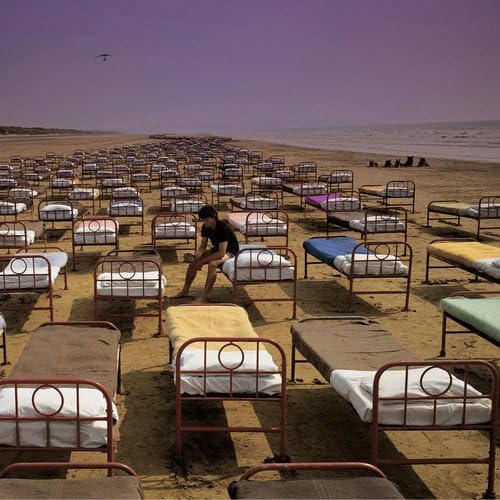
In 1987, the band released their album "A Momentary Lapse of Reason".
The band toured the album around the world. I attended the tour when it reached Manchester, with a concert in the old Maine Road stadium which was home to Manchester City at the time. It took place on the 8th of the 8th, 1988 (and the concert started at 8 minutes past 8. More on that in August.
Here's the setlist that I saw: https://www.setlist.fm/setlist/pink-floyd/1988/maine-road-manchester-england-3bd76478.html
I've previously shared the story of the album cover's creation.
There were real concerns over the possible environmental impact of the concert on the ancient city itself.
The free concert was held in St. Mark's Square in Venice. This was to be a free concert so people travelled in various ways to be there.
The concert is shown periodically on Sky Arts on Freeview.
Local Italian news media were not impressed...
Despite local protests, they were allowed to play a free concert from a barge in the lagoon opposite St. Marks square, from where an estimated 200.000 people watched this concert. The concert was nearly cancelled on July 13th when the City's Superintendent of Monuments claimed that the vibration could damage buildings.
To pacify critics Pink Floyd played a reduced volume, but there were still claims of damage to marble cladding after the concert.
Lamp-posts were also broken by fans climbing them for a better view. The city authorities failed to provide facilities for the visiting fans, many of whom slept in St. Marks square. They left behind them 300 tons of litter, which had to be cleared by the Army. After a seven-hours sitting, the council apologized to Venice residents for the inconvenience, promising that no similar concert wouild ever be allowed. Therefore, this concert can be placed in the books as UNIQUE. The alderman in charge of Venice's Culture Committee, Mr. Silvan Ceccarelli, resigned, explaining: "I feel that I have to go, because I'm one of the people who gave the go-ahead for this concert."
Despite initially refusing to do like wise, the rest of the council went soon after, leaving the city in the hands of an ad-hoc administration.
Over 100 million viewers in 23 countries saw the show on TV.
Pink Floyd also famously played at Pompeii, and the movie of that concert recently had the 4K treatment and a re-release. It's a memorable concert with the band looking remarkably young.